The fragmentation created three distinct pain points, each invisible to the other team:
No one knew where processes stood
Teams could not easily see which tasks were complete, blocked, or at risk. Both teams operated from different document files making it impossible to diagnose or collaborate to troubleshoot errors.
Errors had no clear owner
With unclear task relationships, teams couldn’t pinpoint root causes or troubleshoot with each other. This created unnecessary friction during an already time-sensitive process no one fully owned or understood.
All in their heads
Users had to mentally track or guess dependencies between tasks. This created high cognitive load for users since individual’s workarounds across the multi-team payroll ecosystem were not documented.
The problem
Payroll and Finance teams were stuck in a cycle of delayed month-end closes but no one could pinpoint why.
Closing the books at the end of each month is one of the most critical processes for finance teams. However, the workflow was fragmented.
Teams weren’t struggling with calculations. They were struggling with workflow visibility.
Current state: Fragmented Workflow
Spreadsheet
Tracking
Late Cross-teams Handoffs
Manual
Reconciliation
Checks
Delayed
Month-end Close
Teams Blaming each other
Instead of asking “what task should I do next?”,
users should be able to answer “what’s blocking progress right now?”
Future State Opportunity
See reconciliation
process in one place
Understand task
dependencies
Identify
blockers early
Complete month-end close efficiently & confidently
The design opportunity became:
How might we transform reconciliation from a fragmented checklist into a structured workflow?

The Finance and Payroll team needed help understanding the ownership and relationship between tasks.
With 12 user interviews with both teams, we revealed the important insight: many reconciliation steps depended on others, within and across teams, being completed first.
When this dependency structure wasn’t visible, teams had to constantly ask:
“Has this task been completed?”
“Are we waiting on someone else?”
“Why haven’t we gotten the data?”
“What is causing the delay?”
“Does Payroll need to finish all the tasks to pass it over?”

July - Sept 2025
TL;DR
Two teams. One Close Cycle.
No Shared View.
Key Contributions
Reframed reconciliation as dependency-driven workflows
Designed a clear task progression model
Reduced cognitive overhead in complex financial maps
Every month, Kroger's Payroll and Finance teams closed the books separately. Payroll owns task completion and handoffs. Finance owns final submission but neither could see the other's progress. The dependency structure existed only in people's heads making the OnCycle Payroll process slow and error-prone.
I designed a workflow experience that simplifies reconciliation visibility, reduces manual tracking, and helps teams close faster with confidence.
Focus
Workflow clarity
Task visibility
Error prevention
Core Team
2 PM
1 PD (me)
2 Tech Leads
Stakeholder
Payroll Team
Finance Team
HR
Leadership
The final map reduces the mental overhead of coordinating complex financial steps.
Instead of trying to keep up with spreadsheets, teams now work within a shared workflow view that reflects real progress.
Shifted KPIs to real behavior
Meaningful outcomes refocused
Progress easier to track and trust
Success Criteria clarified across org
Gave stakeholders a shared language
Reduced silos
Aligned conversations
Roles and dependencies visible for the first time
Surfaced cross-team blind spots
Both teams actively using within a week of launch
Clear starting point for prioritization and action
Surfaced 25+ invisible gaps
impact
the value
tradeoffs
our delayed analytics
Tradeoff: Slower path to automation, but faster adoption and trust
Delay advanced analytics in V1
Why: Without clear workflow visibility, predictive insights would add noise instead of clarity
Workflow flexibility vs. simplicity
Challenge: Different teams had unique processes, including workarounds or sub-flows. The solution needed flexibility without overwhelming or confusing users.
Decision: The multi-layered design approach, we’ve created a configurable task template with sensible defaults.
Balancing ideal solution with real-world constraints
If I had another month...
next steps
The OffCycle workflow (an extension of the OnCycle process) is completely undocumented yet it’s causing most of the chronic discrepancies. Without understanding how Off- and OnCycle intersect, teams continue running into unpredictable delays.
Documenting OffCycle Payroll
01 Anamoly detection: Automatically flag unusual reconciliation patterns
“What might block us tomorrow?" with AI Assistance
02 Predictive pattern recognition: Identify tasks likely to delay month-end close
Due to a company reorg, my efforts ended after handing off the artifacts but with the foundation established, these are the strategic opportunities to deepen the solution’s value:
reflections
what this project taught me
Users don’t always struggle with individual work
The friction comes from not understanding how their work connects to others’. Designing for system visibility and relationships reduces cognitive load more effectively than simplifying individual tasks.
Managing evolving scope requires transparency.
Uncovering new complexities with each conversation, Leadership wanting a comprehensive solution but with limited time, I learned to be more transparent on what's critical for immediate execution vs. what needs further investigation.
Designing for visibility and clarity can significantly improve complex operational workflows.
This wasn’t a traditional feature-rich design project. The value came from helping teams see their work differently. Sometimes design’s biggest impact is making complex systems understandable rather than adding more features.
(For NDA purposes, I have obfuscated confidential material and all information in this case study is my own. Final screens and this case study does not necessarily reflect the views of Kroger).
Transforming Month-End Close from chaos to confidence
the solution
Addressing our HMW question, we shifted our focus to system visibility and relationships: when cross-functional teams can't see shared progress, leadership can't trust the process and the organization can't improve it. For finance organizations, a delayed or error-prone close erodes leadership trust, complicates audit readiness, and slows downstream decision-making. This map made that process governable for the first time.
From tribal knowledge to dependency-driven workflows.
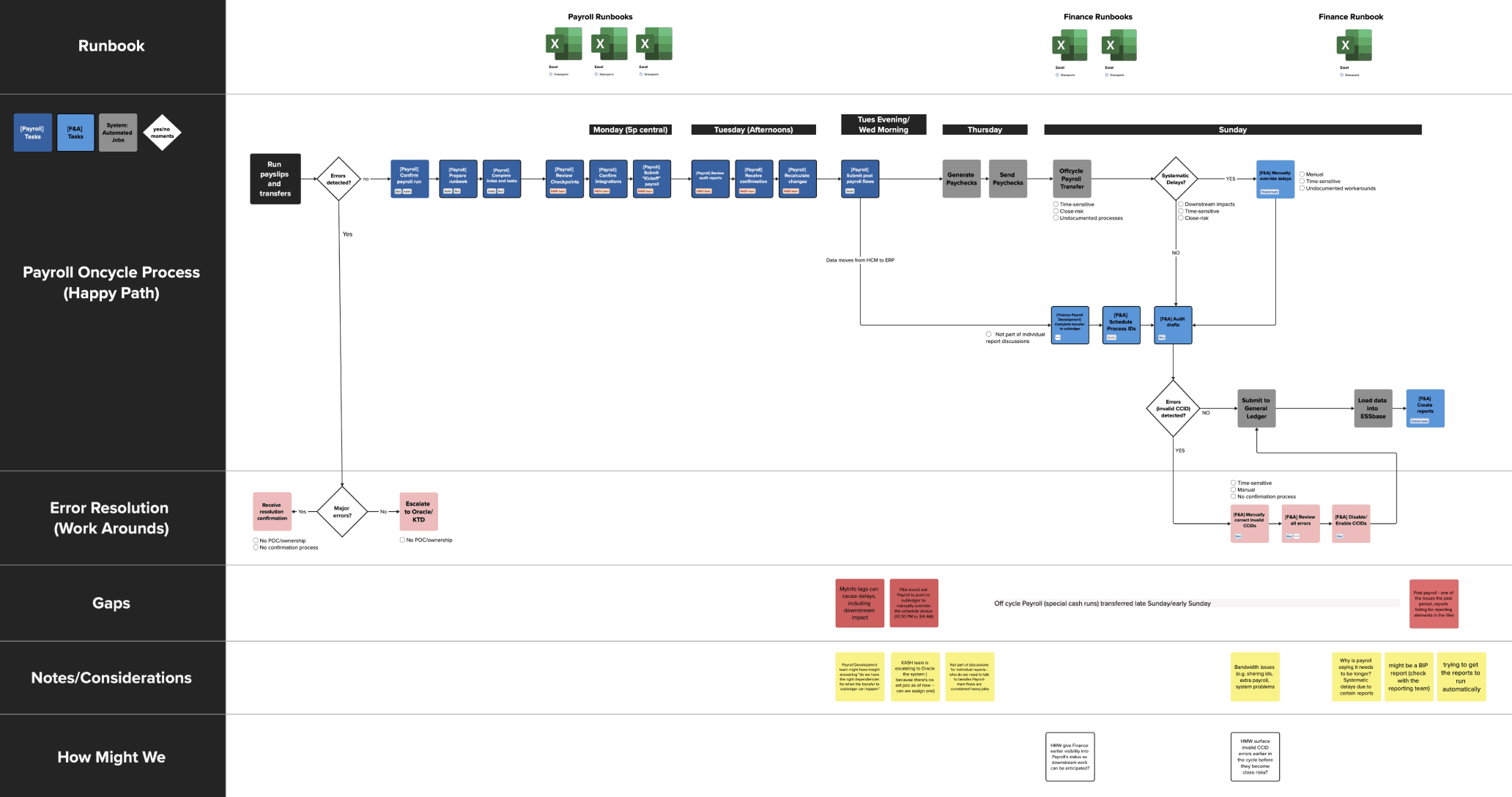
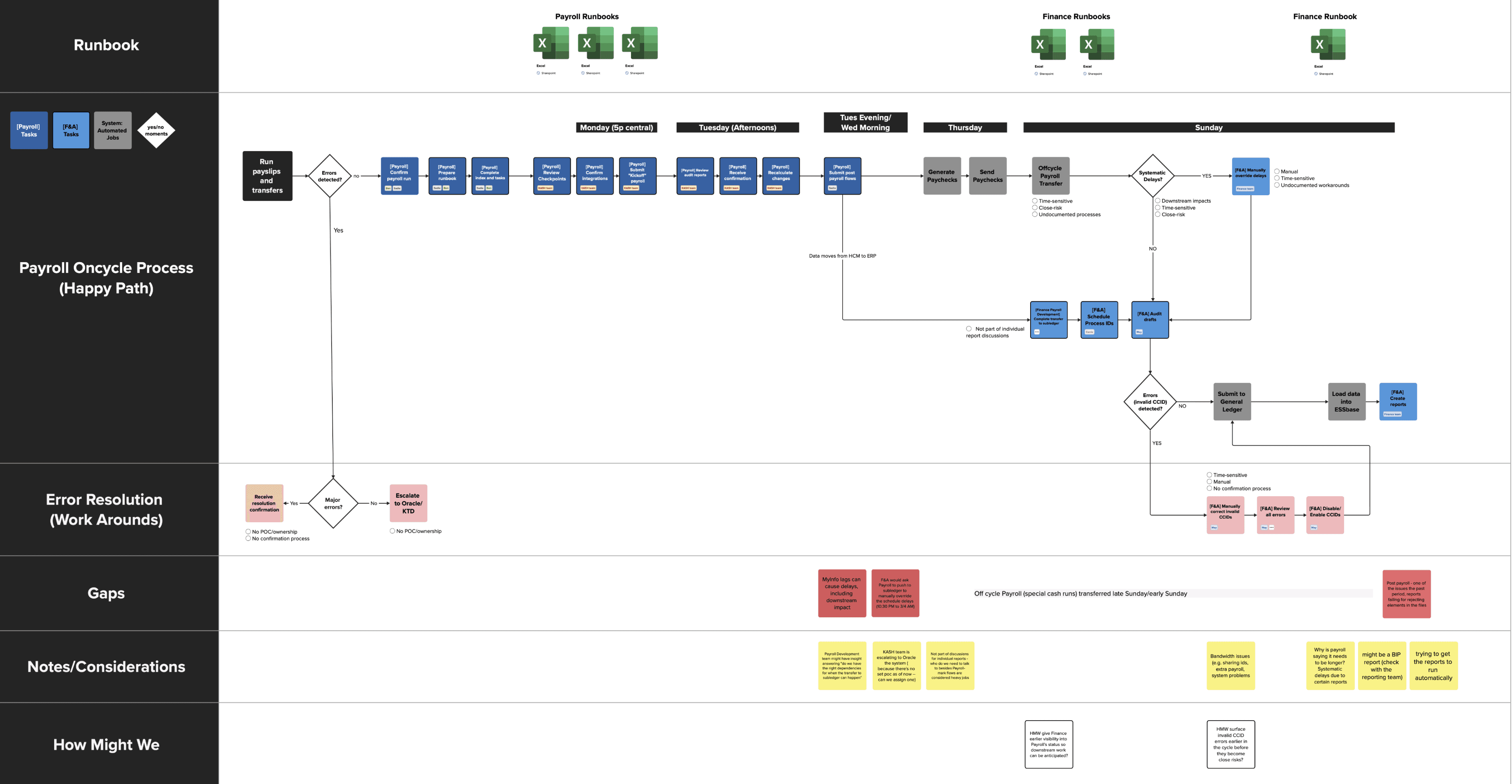
OnCycle Payroll - Unified final workflow organizes reconciliation task dependencies, status visibility, and blocker identification
One Source of Truth
Unite teams on shared visibility and remove mentally tracking cross-team workflow state.
Reduces Cognitive Load
Surface critical information without mental tracking.
Shows Dependencies
Task relationships and blockers are immediately visible, not just the jobs-to-be-done.
Before
Spreadsheet tracking across teams
Email chains for status updates
No visibility into blockers
Delayed month-end close
After
Single workflow view for all teams
Pinpoint and glance real-time visibility
Immediate blocker identification early in close cycle
Confident, efficient close process & reconciliation
discovery & insights
This allows both structural insight into how work was intended to flow (the happy path) as well as adaptation to systemic errors, improving scannability for critical gaps. To improve clarity and reduce friction we found in our user interviews and testing, the design focused on three principles:
The operational structure
Shows task sequences & dependencies
Clear baseline
Surfaces where critical transitions happen
Foundation
Timeline
Payroll Tasks
Finance Tasks
The operational reality
Shows workarounds + frictions, reducing cognitive load
Exposes gaps between architected work vs. how it actually gets done
Experience
Work Arounds
Tools/Files
Happy Path
Surfaces systemic gaps driving workflow breakdowns
Aligns cross-functional teams for intervention
Combined, creates united visibility
Synthesis
Gaps
Notes
How Might We
To highlight these three design principles, we decided on a layered week-in-the-life process map.
Design approach
Although the tasks were interdependent, both teams created their own workarounds to bypass data issues, while having no insight into each other’s work. This insight led to a critical design decision, prioritizing workflow relationships and ownership.
Visibility into dependencies reduces coordination overhead
Task A
[Payroll]
Submits Reports
Task B
Generate
paychecks
Task D
Manually correct errors
(Workaround)
Payroll escalates systemic errors
(Workaround)
Finance manually overrides delays
Task C
[Finance]
Audit drafts
[Payroll doesn’t submit on time]
...
...

July - Sept 2025

Made with
by Christine ©2026